Recent Progress on Developing High Quality Beams for High Resolution
Measurements
We have been developing high quality beams. One of the
purposes of the development is to measure high-resolution
proton inelastic scattering from various nuclei at forward scattering
angles including zero degrees (E214).
Results from a development held on April 2004
Tuning of a halo-free beam with small energy spread has been tried by
using a proton beam at 295 MeV.
- A very small energy spread of 37 keV has been achieved by the achromatic
beam transport. Figure. 1 shows the spectrum of the
197Au(p,p) elastic scattering
which was accumulated for three hours.
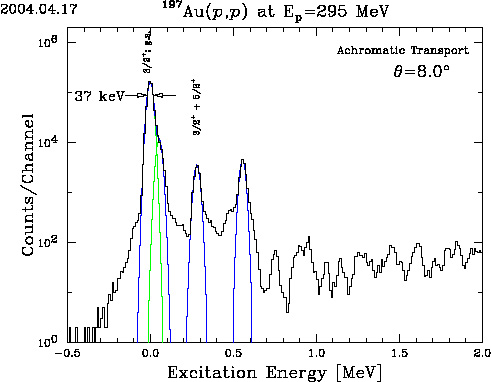
Figure 1. 197Au(p,p) scattering events for measuring the
beam energy spread at the laboratory angle of 8.0 deg. The target thickness
is 1.7 mg/cm2.
An energy resolution of 37 keV has been achieved by the achromatic
beam transport. A tail can been seen at the higher excitation-energy (low-enegy)
side of the ground state peak. The tail has been fitted by a gaussian with
the same width as the one of the ground state. The obtaind peak position
of the tail was 55 keV which was a little bit shifted from the first excited
state of 197Au at 77 keV. Thus a part of the tail was possibly coming from
the beam itself. The continuous background events up to 0.6 MeV were caused
by carbon and oxygen contaminants in 197Au target.
The width of the peaks at 0.28 and 0.56 MeV was 38 and 35 keV, respectively.
- Test of high-resolution measurments of proton inelastic scattering
at 0 deg has been carried out by using lateral and angular dispersion matching
technique.
The targets, 12C, 28Si, and 58Ni were used. Both standard focus
mode and over-focus mode of the GR spectrometer were tested.
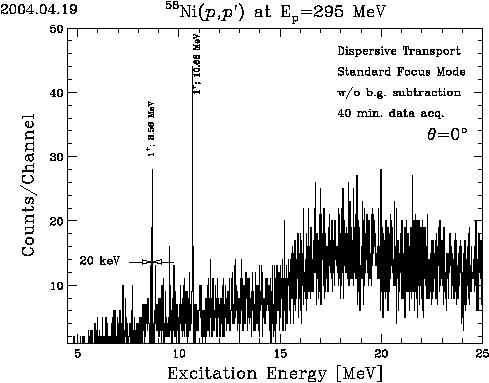
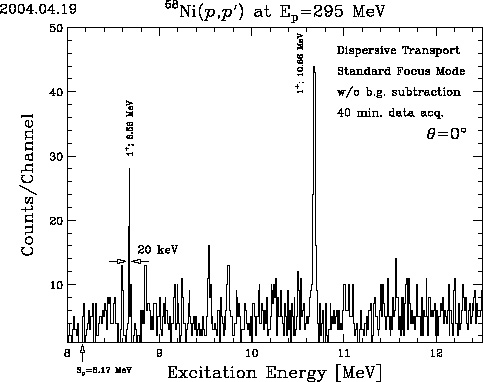
Figure 2 (3) shows the (enlarged) spectrum of the 58Ni(p,p') reaction at
0 degrees with a very small cut (+-0.05deg) of the scattering angles in the
horizontal direction. In this analysis the energy resolution was as small
as 20 keV.
Figure 2. Spectrum of the 58Ni(p,p') reaction
at 0 degrees.
Figure 3. Enlarged spectrum of the 58Ni(p,p')
reaction at 0 degrees. A resolution of 20 keV has been achieved. Note that
the states located at excitation energies higher than the proton separation
energy (Sp=8.17 MeV) may have a larger natural decay width as the excitation
energy increases. The neutron separation energy is Sn=12.22 MeV.
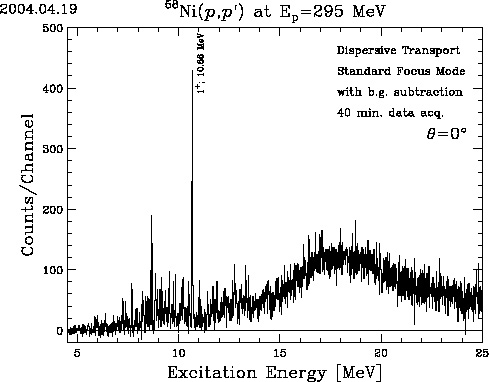
Figure 4 (5) shows the (enlarged) spectrum of the 58Ni(p,p') reaction at 0
degrees with a wider cut (+-0.5deg) of the scattering angles in the horizontal
direction. Background subtraction was applied by using the Y position at
the focal plane.
From the figures it can be seen at least in the region of low-lying discrete
states that the background events were properly subtracted. The energy resolution
was around 32 keV, which is a little bit worse comparing with the figures
2 and 3. The resolution will be possibly improved by a more sophisticated
analysis.
Figure 4. Spectrum of the 58Ni(p,p') reaction
at 0 degrees after background subtraction.
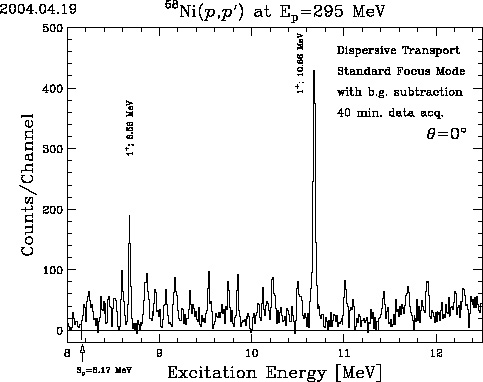
Figure 5. Enlarged spectrum of the 58Ni(p,p') reaction
at 0 degrees after background subtraction.
Results from a development held on October 2003
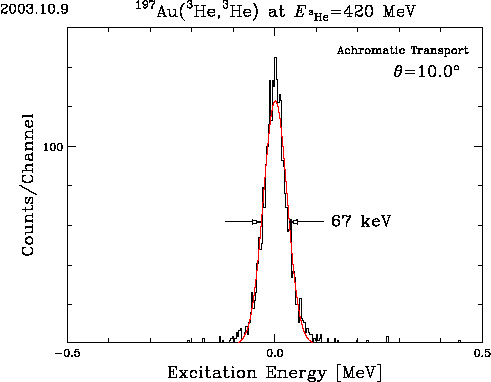
We have succeeded in tuning a beam with very small energy
spread and emittance by using a
3He beam at 420 MeV.
- The highest relative energy resolution (dE/E)
by the achromatic beam transport has been obtained (Fig. 1).
The small energy spread and emittance largely is indespensible
for reliable measurements by the dispersion matching.
Figure 1 : The energy resolution of 67 keV has been
obtained by the achromatic beam transport using a 420 MeV 3He beam.
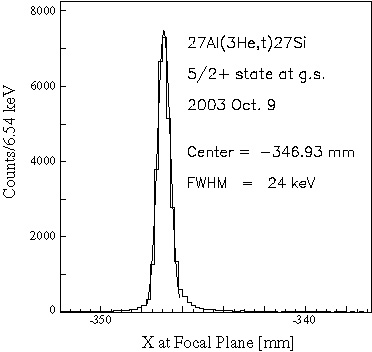
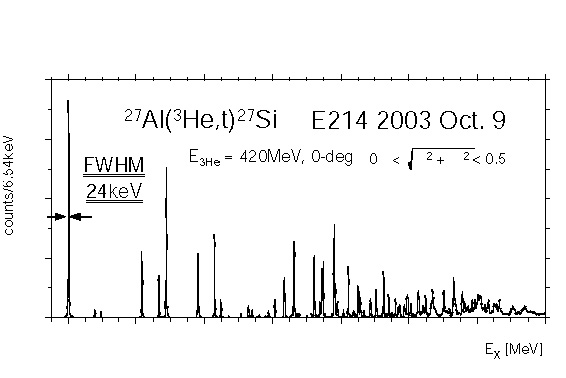
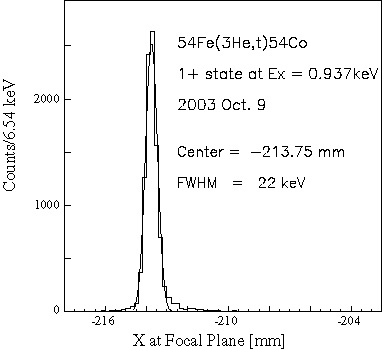
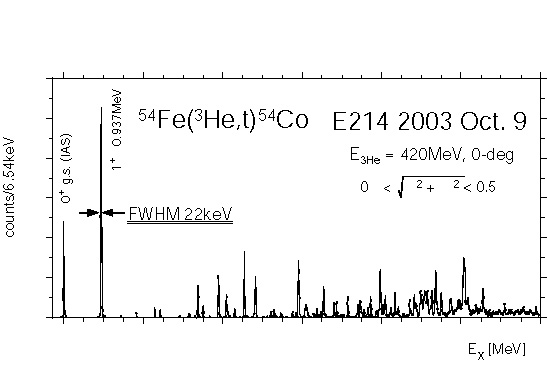
- The highest energy resolution (22 keV) of the (
3He,t) reaction has been obtained by the dispersion
matching method (Fig. 2-5).
(Analyzed by T. Adachi)
-
Figure 2 : The energy
resolution of the 27
Al(3He,t) reaction obtained by the
dispersion matching method.
Figure 3 : The spectorum
of the 27
Al(3He,t) reaction obtained by the
dispersion matching method.
Figure 4 : The energy
resolution of the 27
Fe(3He, t) reaction obtained by
the dispersion matching method.
Figure 5 : The spectorum
of the 27
Fe(3He, t) reaction obtained by
the dispersion matching method.
E214 Collaboration
Spokespersons:
A. Tamii, Research Center for Nuclear Physics,
Osaka University.
Y. Fujita, Department of Physics, Osaka University
.
Experimental Group:
K. Hatanaka, Y. Sakemi, T. Saito, T. Itahashi,
S. Ninomiya, M. Itoh, H.P. Yoshida, M. Uchida, H. Fujita, Y. Shimbara,
Y. Shimizu, K. Nakanishi, K. Fujita, and Y.
Tameshige, Research Center for Nuclear Physics, Osaka University
.
T. Adachi, Department of Physics, Osaka
University.
M. Yosoi, Department of Physics, Kyoto University
.
Last Updated: 28-MAY-2004.